
By Ariel Penn
For decades, talk of UFOs lived in the cultural junk drawer: part Cold War paranoia, part late-night radio, part blurry footage, part “my uncle saw something over the cornfield.” It was fascinating, but not exactly respectable dinner-party conversation.
But something has shifted.
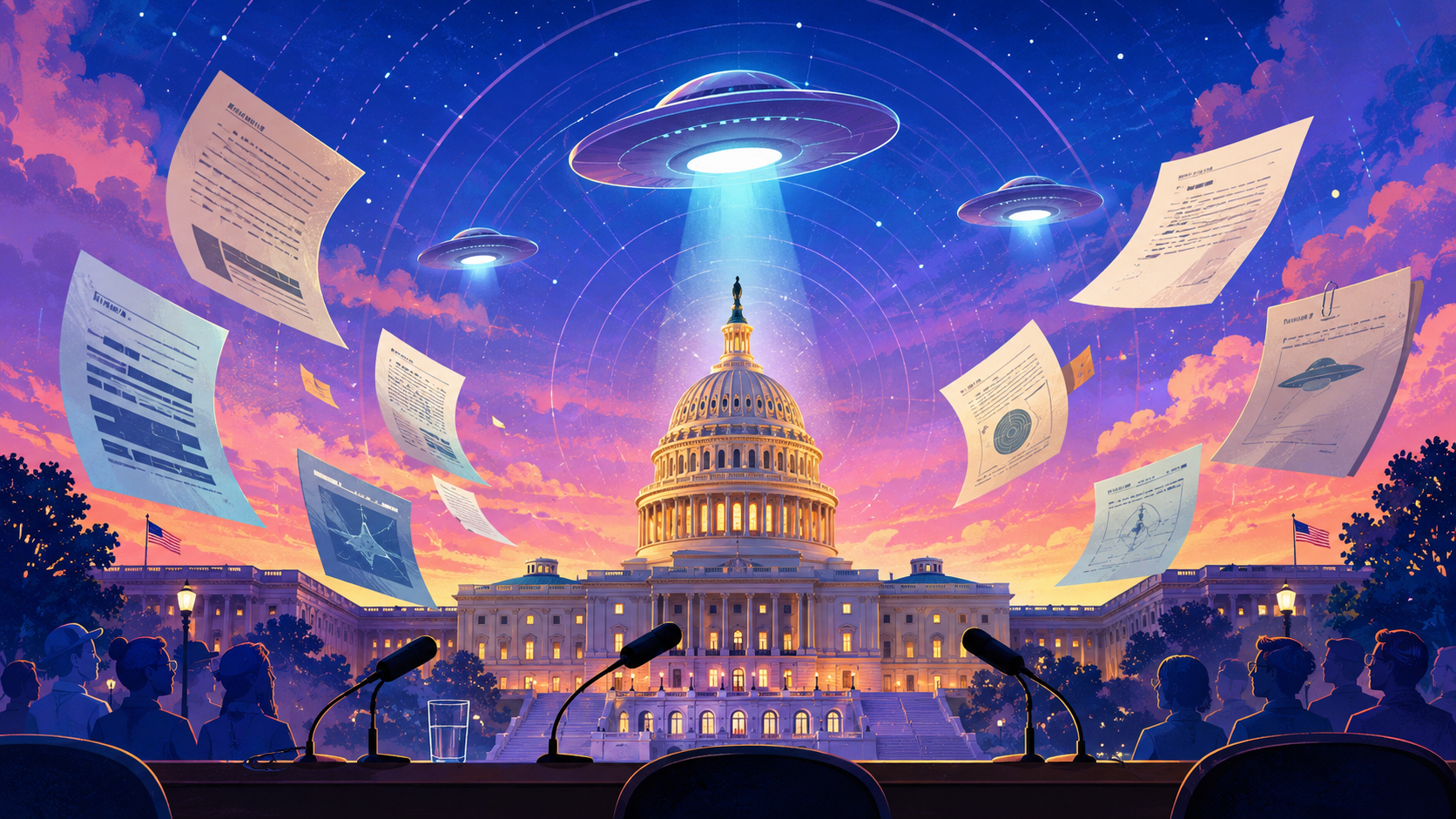
The government is no longer simply waving away every strange object in the sky as weather balloons. Congress is holding hearings. Military pilots are testifying. And this spring, the federal government released large batches of declassified UAP files, including military videos.
So, are we in for a hot alien summer?
Maybe. But the real heat may not be aliens landing on the White House lawn. The real story is disclosure: a slow, uneven movement from secrecy and stigma toward public records, scientific language, and official accountability.
In other words, the question is no longer simply, “Are UFOs real?” The better question may be: “What exactly has been outrunning our finest military pilots in our skies—and why are we finally being allowed to look?”
First, What Is a UAP?
UAP stands for Unidentified Anomalous Phenomena.
That phrase has largely replaced the older term UFO, or Unidentified Flying Object, in official government and scientific discussions. UFO carries decades of pop-culture baggage: flying saucers, little green men, and all the cinematic sparkle that comes with it.
UAP is intentionally broader and more neutral.
The shift matters. “Unidentified” does not mean “extraterrestrial.” It means not yet identified. “Anomalous” leaves room for strange observations that may not fit ordinary categories. And “phenomena” gives investigators space to consider many possibilities without jumping straight to aliens.
That change in language moves the conversation out of belief and into investigation. It gives pilots, scientists, and lawmakers a way to talk about the unknown without immediately turning the room into a sci-fi convention. Though, let’s be honest, a tasteful sci-fi convention would not be the worst thing.
The Congressional Hearings Changed the Mood
One major turning point came on July 26, 2023, when the House Oversight Committee held a public hearing on UAP and government transparency.
The most headline-grabbing testimony came from former intelligence official David Grusch, who alleged that the U.S. government had information about recovered non-human craft and that Congress had been kept in the dark. His claims remain disputed and unverified in the public record, but they dramatically encouraged the public’s interest around UAP disclosure.
Former Navy pilots Ryan Graves and David Fravor brought the issue back to earth, in the best possible way. They spoke about encounters reported by aviators and the need for military personnel to describe what they see without fear of ridicule or career damage.
That may be the most practical takeaway from the hearings: even if many UAP turn out to be drones, balloons, or sensor errors, unidentified objects near military aircraft are still a serious safety concern. Pilots need to be able to say, “I saw something,” without being treated like they just wandered out of a drive-in movie from 1957.
A second major hearing followed in November 2024, focused on transparency and alleged secrecy. Then in September 2025, another House hearing pushed further on whistleblower protections and declassification.
Taken together, these hearings did something culturally significant. They moved UAPs from the fringe into the committee room. That alone is remarkable.
The Government Video Dumps: What We Actually Got
In May 2026, the federal government launched a new UAP disclosure portal called PURSUE, short for the Presidential Unsealing and Reporting System for UAP Encounters.
The first tranche of files was released on May 8, 2026. The second followed on May 22, 2026.
These releases included videos, photographs, documents, and historical records. Some of the videos show objects captured by military sensors. Some cases remain unresolved, not because the government is saying “aliens,” but because officials say there is not enough information to make a firm determination.
That distinction matters.
Unresolved is not the same as extraterrestrial. It means the available data does not yet support a clear answer. A short, grainy clip without enough context may be mysterious, but mystery is not proof of interstellar visitors with chiseled cheekbones.
Still, the releases are significant. For years, the public was told, directly or indirectly, to stop asking so many questions. Now people are being invited to look at declassified records for themselves.
That does not solve the mystery. But it changes our relationship to it.
AARO and the Search for the Ordinary Inside the Strange
The All-domain Anomaly Resolution Office, known as AARO, is the government office tasked with investigating UAP using a scientific and data-driven framework.
AARO’s work offers a helpful reality check. Many UAP reports eventually turn out to have ordinary explanations, such as balloons or drones. That may sound disappointing to anyone hoping for a dramatic first-contact moment, but it is exactly how serious investigation should work.
You identify what you can. You keep studying what you cannot.
AARO has also stated that, to date, it has found no verifiable evidence of extraterrestrial beings, activity, or technology. That conclusion frustrates some disclosure advocates, especially those who believe whistleblowers have described hidden programs and recovered craft. But it remains an important part of the public record.
The tension is the story.
On one side, witnesses and lawmakers are pressing for more disclosure. On the other, official investigators say they have not verified claims of alien technology. Between those poles lies the messy middle: unresolved cases, classified systems, and national security concerns.
That messy middle is where Hot Alien Summer lives.
NASA Wants Better Data, Not Better Campfire Stories
NASA has also entered the UAP conversation, but with a very NASA-like emphasis: data quality.
NASA’s independent UAP study did not set out to prove or disprove alien visitation. Instead, it asked how UAP should be studied scientifically. The agency has been careful to say there is currently no evidence that UAP are alien technologies, while also acknowledging that many reports lack the high-quality data needed for firm conclusions.
If we want to understand unusual observations, we need better reporting systems, better sensors, and less stigma. A blurry clip without distance, speed, weather conditions, or sensor context is intriguing—but not always useful.
The next phase of UAP research may look less like The X-Files and more like a data science problem. Not as glamorous, perhaps, but probably more productive. The truth may not arrive in a silver saucer. It may arrive in a spreadsheet, which is very on-brand for the 2020s.
Meanwhile, the Universe Keeps Getting Bigger
The UAP conversation is happening alongside another major scientific shift: the explosion of exoplanet research.
We now know of millions of confirmed planets beyond our solar system. Scientists believe there may be billions more in our galaxy alone. That does not mean intelligent life is visiting Earth. But it does change the emotional backdrop of the conversation.
A century ago, we did not know whether planets around other stars were common. Now we know they are everywhere.
That is a profound shift. The question “Are we alone?” is no longer purely philosophical. It is becoming observational.
So when people look at UAP disclosures and wonder whether they connect to life elsewhere, they are not being ridiculous. They are living in a moment when the universe feels more populated with possibility than it used to.
So, Are We in For a Hot Alien Summer?
Here is the honest answer: we are in for a hot disclosure summer.
The government is releasing more records. Congress is asking louder questions. Military witnesses are demanding safer reporting channels. NASA is pushing for better data. And the public is no longer content to be patted on the head and told not to worry about the strange things in our skies.
Does any of this prove aliens are here?
No.
Does it prove the old dismissive attitude toward UFOs was inadequate?
Absolutely.
The most interesting possibility may not be that aliens are about to introduce themselves over brunch. It may be that we are watching the birth of a new public framework for studying the unknown—one that includes national security, scientific humility, and a public that has become harder to gaslight.
Maybe the skies are full of drones, balloons, secret aircraft, sensor ghosts, and the occasional truly mysterious object. Maybe a tiny fraction of cases will remain stubbornly strange. Maybe the biggest revelation will not be “they are here,” but “we should have been studying this seriously all along.”
Either way, something has changed.
The universe feels bigger. The files are opening. The language is evolving. The stigma is cracking.
And if this is not quite Hot Alien Summer, it may be something just as interesting: Hot Accountability Summer—with a side of cosmic wonder.